3 Strategic Considerations for Trade Show Booth Location Selection
Last Updated on
October 7, 2026
Share:
3 Strategic Considerations for Trade Show Booth Location Selection | Trade Show Booth Strategy to Maximize ROI
Trade Show Booth Strategy
3 Strategic Considerations for Trade Show Booth Location Selection
Trade show success is not determined simply by foot traffic, but by the quality of attendee interactions. This article explores strategic booth location selection from an ROI perspective, including the advantages and considerations of different booth placement types at U.S. trade shows.
Updated: ·JTB USA
When planning a trade show presence, many companies prioritize booth design and visual elements. While these are important for driving results, the decision made earlier in the process, trade show booth location selection, is significantly more difficult to change later and has a direct impact on overall performance.
This is especially true in U.S. trade shows, where venues are large and attendee profiles and objectives are highly diverse. As a result, where your booth is placed within the exhibition hall directly influences both the quantity and quality of audience engagement.
Trade show success is determined by a combination of factors, including booth design, staff engagement, and content strategy. Among these, the booth location serves as the foundation. It creates the opportunity for interaction, which then leads to conversations, lead generation, and ultimately business outcomes.
Without a strategic booth location strategy, even well-designed marketing efforts may fail to maximize their full potential.
Common Misconceptions in Booth Selection
A common assumption in trade show booth selection is that “high traffic equals better results.” While this may seem logical, it does not always lead to effective outcomes.
High-traffic areas do increase the number of interactions. However, they also attract a large number of non-target attendees. This can dilute your team’s focus, spread resources thin, and reduce the likelihood of generating qualified leads.
If what is important for exhibitors is not the number of attendees, but how efficiently they can connect with their target audience, then effective booth selection requires a structured decision-making process.
Organizing the evaluation around the following three perspectives can help improve booth selection accuracy.
Three Key Factors in the Booth Selection Process
1. Clarify Your Trade Show Objectives
The purpose of exhibiting is not simply participation, but achieving measurable business results. Common objectives include:
Increasing brand awareness
Generating qualified leads
Building ongoing relationships
Your objective significantly influences the optimal booth location strategy. For example, awareness-focused goals prioritize visibility, while lead generation requires precise audience targeting.
2. Understand Attendee Flow and Behavior
Trade show attendees have different goals and interests. Identifying where your target audience is most likely to be and how they move through the venue is critical.
Key traffic areas typically include:
Entrances and exits
Main aisles
Seminar and conference areas
Networking, lounge, and dining spaces
Areas surrounding high-profile and large booths
However, the key is not simply where traffic is highest, but understanding what type of attendees are moving through each area.
For instance, attendees leaving a seminar on a specific topic often have strong interest and clearly defined challenges. Positioning your booth along these paths increases the likelihood of high-quality engagement and meaningful conversations.
3. Evaluate Booth Location Using Multiple Metrics
To optimize trade show ROI, booth location should be evaluated across several factors:
Visibility: Can your booth be recognized from a distance?
Traffic volume: How many interaction opportunities exist?
Target alignment: Are your ideal prospects passing through?
Competitive context: Are relevant or competing companies nearby?
Dwell time potential: Are attendees likely to stop and engage?
These factors often involve trade-offs. For example, high-traffic areas may reduce targeting accuracy, while highly visible open booths may limit engagement duration.
Balancing these elements based on your objectives is key to effective decision-making.
Booth Location from an ROI Perspective
Exhibiting at U.S. trade shows often requires significant investment. However, traditionally “premium” locations such as main aisles, entrances, or island booths are not always the most effective.
By aligning booth location with your objectives, attendee flow, and evaluation criteria, it is possible to achieve strong results without selecting the most expensive option.
It is important to recognize that booth location is not just a cost. It is an investment that generates opportunities for engagement, which are then converted into results through design and execution.
Success should be measured not by price, but by how effectively the location contributes to target engagement and business outcomes.
Key Booth Location Types and Their Characteristics
1. Main Aisles and Island Booths (Open on All Four Sides)
Overview
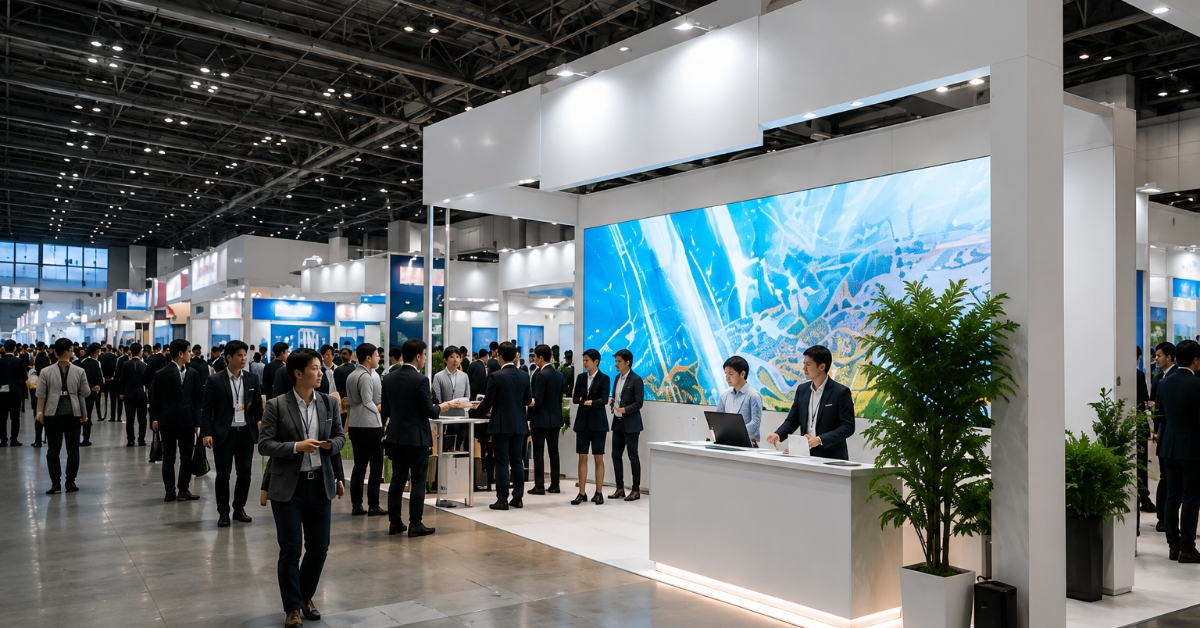
These locations offer the highest level of foot traffic and visibility within the exhibition hall, providing some of the strongest opportunities for brand exposure across the entire trade show floor.
Advantages
Highly visible even from a distance, making it easier to maximize brand exposure and generate spontaneous attendee interactions
More likely to leave a lasting impression across the overall exhibition experience, increasing the chance of being remembered as “a company attendees kept seeing throughout the show”
Effective for expanding initial awareness when entering new markets or launching new products
Considerations
Traffic flow is typically fast-paced, with many attendees simply passing through the aisle. Booths in these locations require deliberate strategies to encourage attendees to stop and engage long enough for meaningful interaction
Near entrances and exits, attendees often postpone visiting booths with the intention of “coming back later,” but many never return
Island booths, while highly open and visible, can make it easier for attendees to walk through without stopping. In addition, the limited wall space can make it more difficult to communicate detailed product information or brand storytelling. As a result, greater emphasis is often required in structural design, including booth height, traffic flow planning, and visual presentation, which can increase overall production costs
Best Fit
Well suited for companies prioritizing brand awareness expansion, particularly Japanese companies entering the North American market for the first time. In these cases, the objective is often not short-term lead volume, but rather long-term brand recall, visibility, and branded search growth.
Strategic Considerations
To prevent attendees from simply walking past, it is critical to create messaging that communicates what the company does and what makes it different within the first three seconds
Booths should be designed assuming attendees may only view them while walking past or from the side. Information hierarchy should prioritize instant understanding over depth of explanation
Rather than relying solely on static panel displays, visual hooks such as large LED displays, motion graphics, or dynamic visual elements are highly effective for increasing attention, memorability, and overall brand impact
2. Booths Located Near High-Profile & Large Exhibitors
Overview
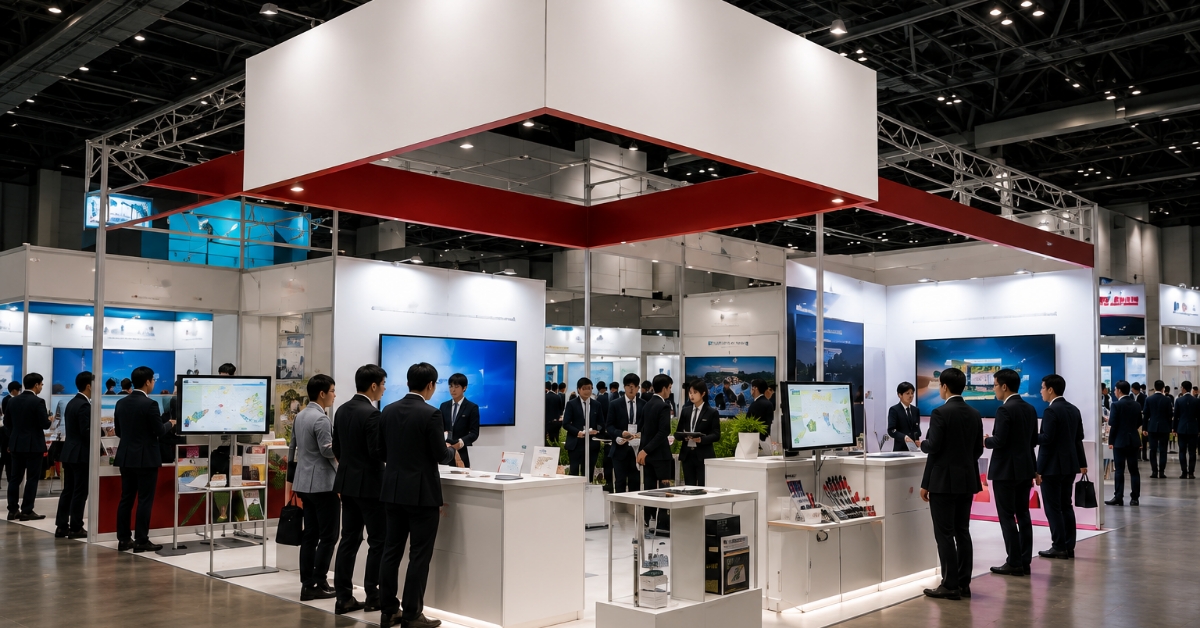
These booth locations are positioned near high-profile and large exhibitors that attract attendees with a specific purpose or purchasing interest, allowing smaller exhibitors to enter the attendee’s comparison and evaluation process.
Advantages
The quality of traffic tends to be higher because attendees visiting high-profile and large booths often already have defined interests or active business challenges
Conversations tend to progress more naturally since attendees are already engaged with the category, increasing the likelihood of qualified leads and business opportunities
Being located near competing or related companies can position your brand as part of the attendee’s active comparison process
Considerations
If booth presence and messaging are weak, the booth can easily be overshadowed by higher-profile and larger exhibitors nearby
Stronger differentiation in presentation, positioning, and booth content is required to stand out among competitors
If the relationship between your offering and the surrounding exhibitors is unclear, traffic generation may be limited
Best Fit
For example, at HVAC trade shows, companies providing motors, control systems, refrigerant-related components, or piping systems near major equipment manufacturers can naturally connect with attendees facing similar technical or operational challenges.
Because attendees in these areas are often already in a comparison or solution evaluation phase, clearly communicating differentiation points can significantly improve the likelihood of business discussions and lead conversion.
Strategic Considerations
Booth design should immediately communicate how the company differs from competing exhibitors nearby
Trade shows should be viewed not only as places for information gathering, but also as environments for comparison, evaluation, and solution exploration
In some cases, booth locations positioned one aisle away from high-profile and large exhibitors can provide a stronger balance of relevance, visibility, and cost efficiency. These locations may also offer a quieter environment better suited for business conversations and meetings
Industry Trends
Trade shows are evolving from information-focused events into environments centered around comparison, evaluation, and decision-making
Companies are increasingly prioritizing lead quality, conversion rates, and opportunity creation over total lead volume
Messaging is shifting away from product-focused promotion toward solution-based value propositions
3. Booths Near Seminar and Conference Areas
Overview
These areas attract attendees with strong interest in specific topics and clearly recognized business challenges, making them highly valuable zones for solution-oriented engagement.
Advantages
Attendees typically have well-defined interests and stronger problem awareness, making conversations more likely to lead to meaningful opportunities
Since seminar participants already share a baseline understanding of the topic, communication and explanation efficiency improve significantly
Exhibitors can align proposals and messaging directly with seminar themes and attendee interests
Considerations
Results depend heavily on the relevance between seminar content and the exhibitor’s offering, requiring careful evaluation beforehand
Traffic flow tends to spike immediately before and after sessions, creating busy environments that can make in-depth engagement more difficult
Visitor volume may decline during periods when seminars are not actively taking place
Best Fit
At trade shows featuring seminars on topics such as AI implementation, labor reduction, sustainability, or decarbonization, companies offering practical solutions related to those challenges are particularly well positioned in these areas.
Seminar attendees are often already in a mindset of recognizing a problem and actively searching for solutions. As a result, conversations that focus not only on products, but on how specific challenges can be solved, are more likely to develop into concrete business discussions.
Strategic Considerations
Messaging should align directly with seminar topics and attendee expectations
Booth layout and visitor flow should anticipate attendee movement immediately after sessions end
The booth experience should enable quick progression into the next step, such as demos, downloadable materials, or consultation opportunities
Industry Trends
Trade shows are increasingly integrating with content marketing strategies
Seminar experiences are no longer treated independently, but as part of a broader attendee journey that includes booth engagement
Lead generation strategies are increasingly designed around long-term nurturing rather than immediate conversion alone
4. Booths Near Networking, Lounge, and Dining Areas
Overview
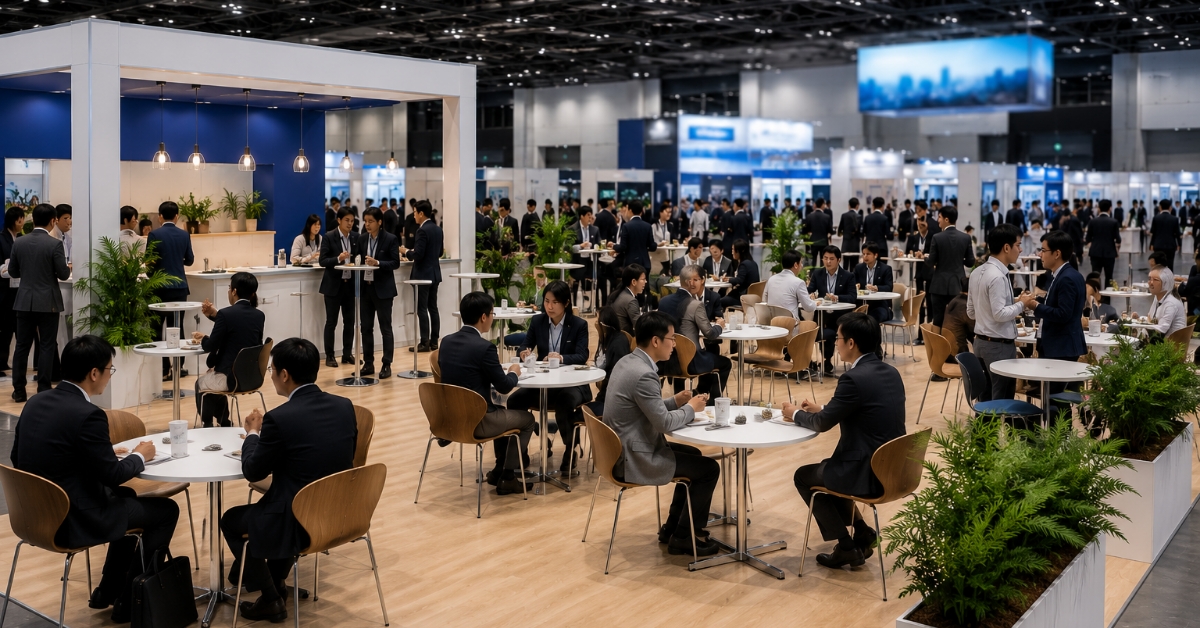
These areas provide lower psychological barriers for engagement, allowing exhibitors to interact with attendees in a more relaxed and natural environment.
Because conversations occur in a less formal setting, exhibitors may also encounter attendees outside their usual target audience, including professionals from industries or functions they may not normally engage with. In some cases, this can lead to the discovery of entirely new market opportunities.
Rather than focusing on immediate sales discussions, these areas are often more effective for creating memorable brand experiences through short-form interactive content, social media-friendly activations, demonstrations, or sampling experiences.
For companies looking to generate curiosity and encourage hands-on engagement through tastings, product experiences, or live demos, these locations can be especially effective.
Leveraging External Expertise
As outlined above, trade show booth location selection is a complex, strategic decision requiring multiple layers of analysis, including venue dynamics, attendee behavior, and past performance insights.
By working with an experienced partner, companies can move beyond intuition and make data-driven decisions, understanding not just which location to choose, but why it is optimal.
This leads to improved performance and maximized ROI.
At JTB USA, we support not only booth location strategy but also end-to-end execution, including design, production, and on-site operations. This integrated approach reduces internal workload, enables teams to focus on business development, and ultimately enhances trade show outcomes.
If you are planning a trade show or struggling with booth location selection, we are here to help.
To better understand booth location strategy, it is also important to understand the basic structure of U.S. trade shows and how they differ from exhibitions in Japan. The following guide explains key preparation points and strategic considerations for companies planning to exhibit in the United States.
Turn ideas and insights into meaningful experiences.
MEETINGS
Plan and manage meetings with greater efficiency, clarity, and impact through experienced support from preparation to on site execution and post event review.
Create memorable incentive programs that motivate participants, strengthen relationships, and connect shared experiences with your business objectives.
Bring your objectives, audience, content, venue, and production together to create corporate events that strengthen engagement and leave a lasting impression.
Build a strategic exhibition experience that strengthens your brand, connects with the right audiences, and turns trade show participation into measurable business opportunities.
Strategic Meeting Management (SMM) helps organizations move beyond managing meetings individually by connecting processes, spend, suppliers, technology, risk, and data across the enterprise. This article explains the seven key areas of SMM and how greater visibility can improve efficiency, compliance, and business value.
As business events continue to recover worldwide, experienced meeting professionals remain in short supply. Organizations are increasingly expected to deliver strategic, high quality meetings with limited internal resources. This article explores how Corporate Meeting Management (CMM) and Certified Meeting Professionals (CMPs) help organizations improve governance, attendee experience, and measurable business outcomes.
What if sports hospitality could become one of your most powerful corporate engagement strategies? See how JTB's Los Angeles Dodgers partnership transforms game day into an unforgettable business experience.