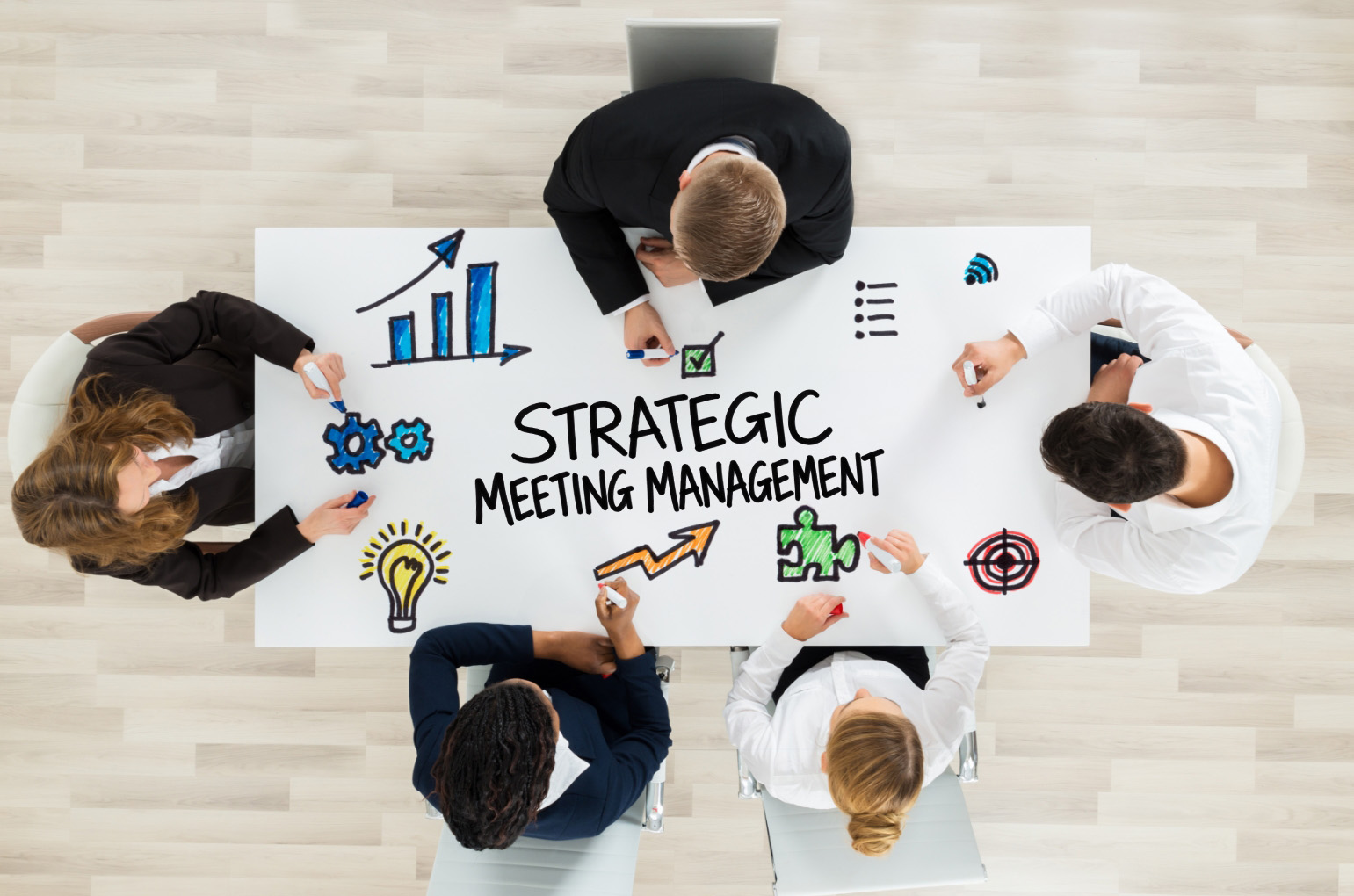
What Is Strategic Meeting Management (SMM)? A Strategic Approach to Optimizing Meetings & Events Across the Enterprise
Last Updated on
September 17, 2026
Share:
Strategic Meeting Management (SMM): Enterprise Meeting Strategy | JTB USA
Updated: ·JTB USA
From Individual Meeting Success to Enterprise-Wide Strategy
In our previous blog, we explored key considerations for successfully managing meetings during the planning stage from a Corporate Meeting Management (CMM) perspective, as well as the important role of CMPs (Certified Meeting Professionals).
These considerations can help make each individual meeting a success.
However, from an enterprise-wide perspective, organizations conduct a wide variety of Meetings & Events across multiple departments and regions. These may include internal activities such as Sales Meetings, Kick-Off Meetings, and Employee Seminars, as well as external-facing activities such as Business Partner Meetings, Incentive Programs, Dealer Meetings, Shareholder Meetings, and Investor Seminars.
So, how should companies approach and manage these diverse Meetings & Events across the organization?
In this article, we introduce SMM (Strategic Meeting Management), an approach that extends successful Meeting Management from individual meetings to an enterprise-wide strategy.
Why Organizations Need Strategic Meeting Management
SMM is an enterprise-wide approach to strategically managing and optimizing Meetings & Events by integrating processes, spend, suppliers, technology, risk, and data. While it may appear to focus primarily on the organization as a whole, it ultimately drives greater business impact not only across the enterprise, but also at the level of each individual event.
Organizations have multiple departments, each with different objectives and needs. As a result, Meetings & Events are often managed independently by each department based on the idea that “our objectives are different” or “our processes are different.”
Managing Meetings & Events independently may appear efficient and agile. However, from an enterprise-wide perspective, this approach does not always lead to the best results.
For example, even when organizing similar Meetings or Events, using different venues or suppliers and following different processes for obtaining quotes and approvals can result in additional time, administrative effort, and costs. It can also make it difficult to gain visibility into the company’s overall Meeting & Event Spend.
In addition, when information about past negotiations and contracts is not shared across departments, organizations may not be able to fully leverage the knowledge and data they have accumulated over time.
Effective cost control is also becoming increasingly important. According to Cvent’s 2026 Cvent Planner Sourcing Report, 72% of planners expect event costs to increase, while 35% identify staying within budget as their top concern. These figures highlight the growing importance of effective Meeting & Event cost management and reinforce the need for enterprise-wide visibility into Meeting & Event Spend.
Compliance is another important consideration, as managing Meetings & Events independently by department can create unexpected risks.
7 Key Areas of Strategic Meeting Management
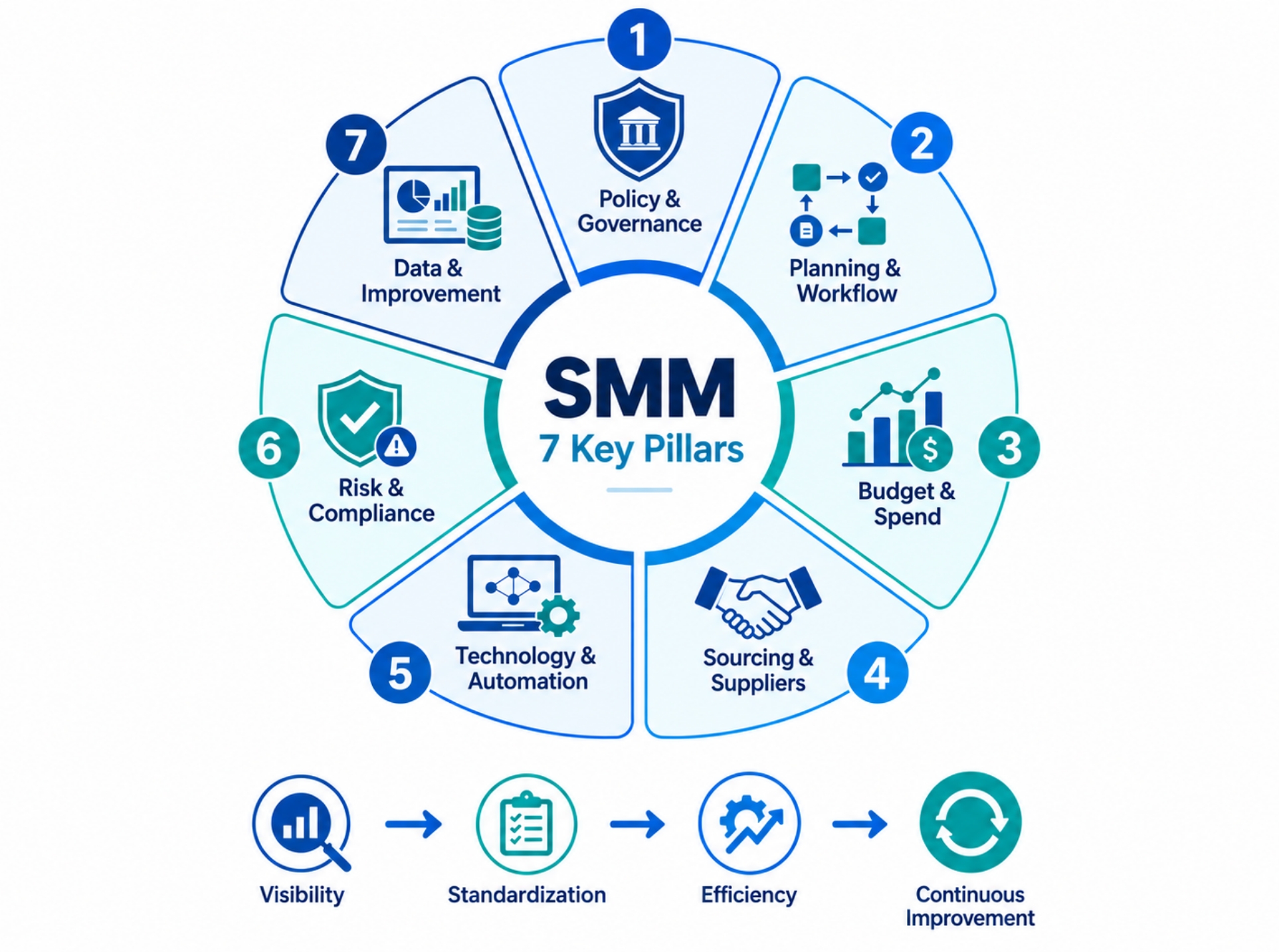
SMM takes a holistic view of the information, processes, and activities associated with Meetings & Events. To put this enterprise-wide approach into practice, SMM can be organized around seven key areas:
01: Governance & Management Structure
Establish management policies, approval criteria, and roles and responsibilities across departments.
02: Planning & Business Processes
Define and streamline processes from request and approval through execution and post-event reporting.
03: Budget & Spend Management
Gain visibility into Meeting & Event Spend and manage budgets and costs effectively.
04: Procurement & Supplier Management
Manage RFPs, negotiations, contracts, and supplier performance.
05: IT & Operational Efficiency
Connect processes such as requests, approvals, budget management, and reporting through technology to improve efficiency.
06: Risk & Compliance Management
Manage risks related to contracts, approvals, attendee safety, personal information, and other compliance requirements.
07: Data Utilization & Continuous Improvement
Analyze data such as spending, attendance, and supplier performance to identify opportunities for improvement.
The key is not to manage these areas independently, but to connect them and manage them as part of an integrated approach.
From Visibility to Business Value
A critical first step in SMM is gaining visibility into Meetings & Events across the organization.
Which departments are organizing which types of Meetings or Events? Which suppliers are being used? How much is being spent?
By gaining visibility across the organization, companies can identify opportunities to optimize costs, manage risks, review and strengthen supplier relationships, and improve business processes.
Create Visibility→Analyze→Improve→Drive Business Value
Continuously repeating this cycle across the organization is an important part of SMM.
What Types of Companies Can Benefit from SMM?
SMM is particularly effective for organizations where Meetings & Events are held throughout the year across multiple departments or regions.
Even a single department that regularly holds Meetings & Events of similar size or purpose can benefit from applying SMM principles to enhance operational efficiency and optimize costs.
SMM may be particularly valuable for companies facing challenges such as:
Annual Meeting & Event Spend is not fully visible or tracked
Application and approval processes differ across departments
Supplier information and negotiation history are not shared across the organization
Different rules and processes are used across regions or locations
Past data is not being fully leveraged to inform future planning
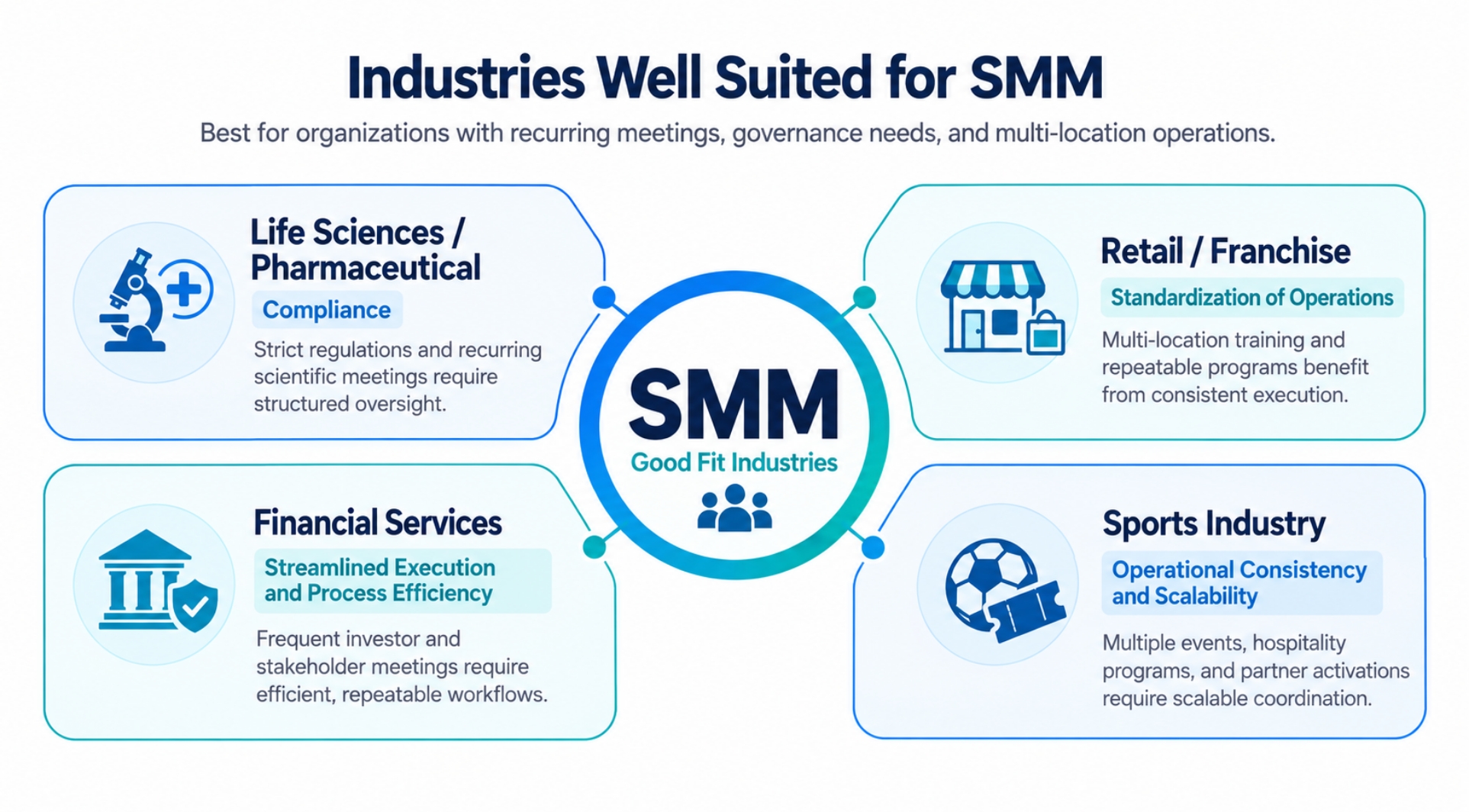
From an industry perspective, SMM can deliver value across a wide range of sectors, not only manufacturing companies that conduct a high volume of Meetings & Events, but also industries with different business requirements and operational challenges.
Examples include the Life Sciences & Pharmaceutical industry, where compliance is a top priority; the Retail and Franchise industry, where standardization across multiple locations is essential; and the Financial Services industry, where Investor Meetings and other events are held frequently, making streamlined execution and process efficiency particularly important.
The sports industry can also benefit from SMM. For recurring tournaments, competitions, and other sporting events, applying SMM principles can help improve operational consistency and scalability while enhancing the experience of both participants and spectators.
In this way, SMM is not limited to companies that simply hold a large number of Meetings & Events. It is a valuable approach for organizations seeking to take a cross-functional view of Meeting & Event-related processes, spend, suppliers, and data, and use these insights to drive continuous improvement.
How JTB USA Can Support Your SMM Journey
Implementing SMM does not necessarily mean introducing a new system from the outset.
The first step is to understand how Meetings & Events are currently planned and managed within the organization. This includes reviewing the number of Meetings & Events, spending, planning and operational processes, suppliers, technology, compliance, and risk, and then identifying key challenges.
Based on these findings, policies, workflows, and other processes can be designed to align with the organization’s structure and the characteristics of its Meetings & Events.
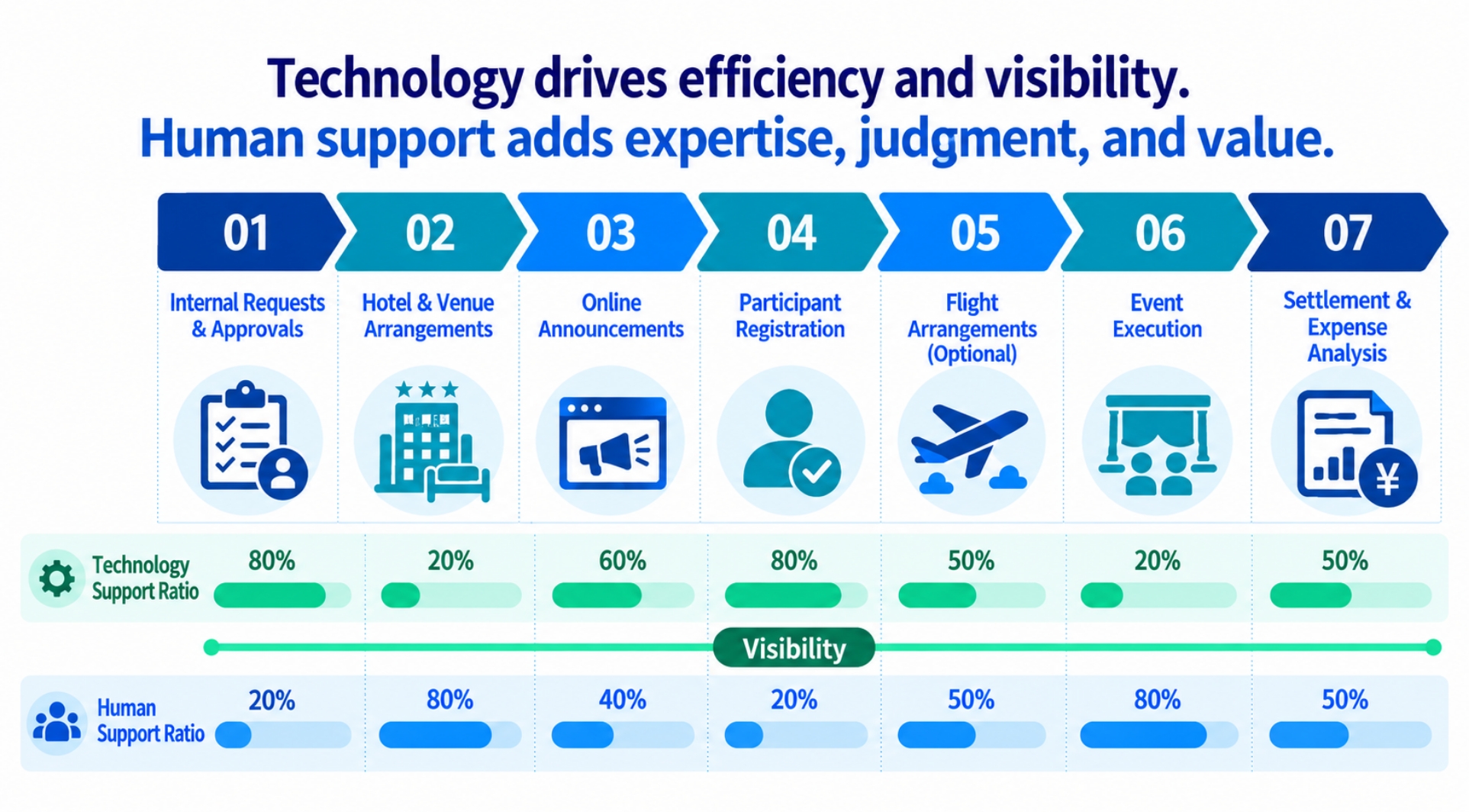
While technology plays an important role in SMM, technology itself is not SMM.
Technology is a tool for efficiently implementing the policies and workflows established by the organization, as well as for collecting, managing, and visualizing Meeting & Event data.
For example, by connecting processes such as internal requests, approvals, venue selection, attendee registration, event execution, and post-event evaluation through technology, organizations can manage Meeting & Event information centrally and improve visibility across the enterprise.
At the same time, certain activities, such as contract management, payment, and budget adjustments, require situational judgment and cannot always be handled through standardized processes alone. Support from experienced professionals with the right knowledge and expertise is therefore essential. This is where CMPs (Certified Meeting Professionals), introduced in our previous blog, can play an important role.
Technology creates the “framework,” while people provide the “judgment and support.”
Combining these two elements enables organizations to move beyond managing Meetings & Events individually. Instead, they can leverage information, data, and knowledge across the organization to manage and optimize Meetings & Events more effectively and efficiently.
Through JTB USA’s Corporate Engagement & Event Solutions, we provide Meeting Management tailored to each organization’s needs, from assessing current Meetings & Events operations to identifying opportunities, designing effective processes, and implementing solutions that enhance visibility, efficiency, and continuous improvement across the organization.
Whether your organization is just beginning its SMM journey or looking to strengthen an existing Meeting Management program, JTB USA can help you take a strategic approach to Meetings & Events and turn them into greater business value.
For a closer look at managing the quality and success of individual meetings, explore how Corporate Meeting Management and CMP expertise support planning, execution, risk management, and measurable business outcomes.
Turn ideas and insights into meaningful experiences.
MEETINGS
Plan and manage meetings with greater efficiency, clarity, and impact through experienced support from preparation to on site execution and post event review.
Create memorable incentive programs that motivate participants, strengthen relationships, and connect shared experiences with your business objectives.
Bring your objectives, audience, content, venue, and production together to create corporate events that strengthen engagement and leave a lasting impression.
Build a strategic exhibition experience that strengthens your brand, connects with the right audiences, and turns trade show participation into measurable business opportunities.
Strategic Meeting Management (SMM) helps organizations move beyond managing meetings individually by connecting processes, spend, suppliers, technology, risk, and data across the enterprise. This article explains the seven key areas of SMM and how greater visibility can improve efficiency, compliance, and business value.
As business events continue to recover worldwide, experienced meeting professionals remain in short supply. Organizations are increasingly expected to deliver strategic, high quality meetings with limited internal resources. This article explores how Corporate Meeting Management (CMM) and Certified Meeting Professionals (CMPs) help organizations improve governance, attendee experience, and measurable business outcomes.
What if sports hospitality could become one of your most powerful corporate engagement strategies? See how JTB's Los Angeles Dodgers partnership transforms game day into an unforgettable business experience.